Posts

CelloPointe Rehearsal Day 1

Today I began rehearsals for a new piece to be premiered in a concert on March 30th. The concert, “CelloPointe”, fuses contemporary ballet and all live cello performances. There is an impressive roster of choreographers, musicians, and dancers on board and I am excited to be involved. My contribution is an original work set on Dona Wiley and Morgan Stinnett—both from the Connecticut Ballet . Dona was a student of mine and I set pieces on her last year for the concert "String Theory." This was my first time meeting Morgan. It turns out that he is from Akron, OH—small world after all. He studied with Nan Klinger, took a class from my ballet teacher Inna Stabrova, and was even in a piece my dear friend Bill Hastings set on the Cuyahoga Valley Youth Ballet. I try to avoid gross generalizations, but Morgan supports the one about Midwesterners being easy to get along with. Both Dona and Morgan are really generous and humble young artists and I really appreciate that. We began g...
In What Way Am I A Buddhist?

Image
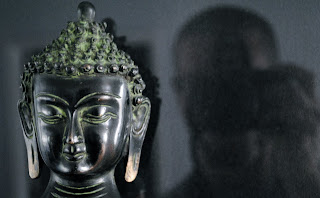
In my tagline for this blog I write...”navigating the shifting seas of life as a dance-maker, teacher, and buddhist.” Since different people have different definitions--as well as different (mis)understandings--of what being Buddhist means, it might be helpful (at least for me) to clarify my personal perspective. The teachings of Siddhartha Gautama (a.k.a. the Buddha) have spawned a wide variety of traditions, beliefs, and practices--some religious, some philosophical. From my perspective, I embrace Buddhism as a philosophy, not as a religion. I believe Siddhartha’s original teachings were not meant to be religious or metaphysical. Although, he did allow that an understanding that still included many of the folk traditions, rituals, and myths of the respective cultures was acceptable until a deeper understanding was reached.  So, I don’t buy into the magical/mythical/metaphysical attributes to which some traditional Buddhist perspectives adhere. Rather, I see the metaphysical...

Dance Paradigms (Part 9: Applications for Dance Education)

Image
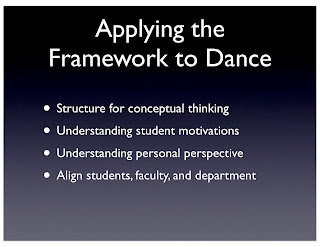
So, how can the Graves framework be incorporated and applied to dance education? I think it can offer an organizational structure for college dance students that will introduce conceptual thinking toward their craft. While not all undergraduate students would care to understand the development of dance beyond the platitudes they often hear, some may gain a greater understanding of the ideas behind the movements.    Of all the arts, dancers are often saved from the rigors of intellectual thought because we are physical artists and not to be labored with such thinking. However, I believe that this is an old Cartesian modernist mind-body prejudice. Presenting the information will at least give those dancers that are interested the ability to grow into knowledgeable, passionate, thinking artists. And for those who would rather not consider it, we would just accept that they are in the state that suits their current psychological conditions. At the dance studio in Long Island ...

Dance Paradigms (Part 8: Transmodern Dance)

Image
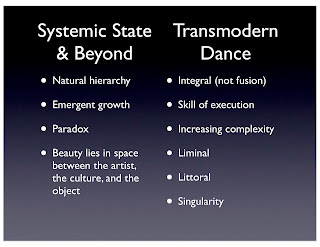
Graves suggests the next level beyond Relativistic postmodernism is the Systemic state. The Systemic state builds off of the strengths and weaknesses of the Relativistic state. The pluralistic relativism that postmodernism brought to our society insisted on seeing all states as equal in order to upend oppressive hierarchies. In seeing traditional dance as equal to classical as equal to modern as equal to postmodern, relativistic thinking ignored the natural increase in complexity and growth. Systemic thinking, in contrast, embraces this pattern of development as a natural, not oppressive, hierarchy. Systemic thinking believes that universals do once again exist, but that most of what we understand is contextual and we could never know for sure that the universals we personally believe in are indeed universal. Therefore, Systemic thinking is comfortable with paradox. Beauty does not lie in the object alone, or in the artist alone, or in the viewer alone. Beauty lies in ...

Dance Paradigms (Part 7: Postmodern Dance)

Image
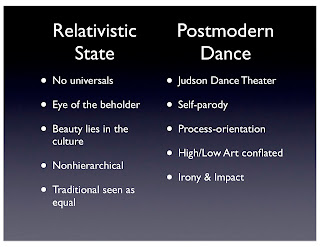
Following the Absolutistic and Multiplistic states, Graves called the next stage of development the Relativistic state. With the Relativistic state, we enter the world of contemporary postmodernism. Beauty is no longer absolute—it is, “created by culture and determined by human view” (Martin-Smith). No universals exist. It is personal to the extreme: whatever the artist says is beautiful is beautiful. Personally, when I tired of the achievement oriented modernist uptown dance scene in New York City, I started to explore different approaches in order to find a more personally relevant voice. And, as my body no longer had the elasticity and bravura strength of my youth, I explored ways of moving that were not simply about spectacular displays of skill. And in this exploration, I started to choreograph. Unfortunately, my palette of movement options was greatly limited by my technical training. I was becoming postmodern in my thinking without an awareness of the postmodern movement i...

Dance Paradigms (Part 6: Modern Dance)

Image
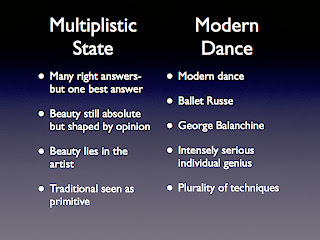
The transition for Graves from the Absolutistic to the Multiplistic existence surfaces in a change from “a submissive state to one of selfish independence”. The shift from Medeival Times into The Enlightenment is the large-scale rendition of this transition. It is Multiplistic because now there are a plurality of right answers—not just one. In the case of the dancer, she begins to question the dogma she has been reared on in order to find the way, perhaps the style, that works for her personally. My final year of college I started to doubt my discipline. I mean, I embraced how it helped me become a much stronger technician than I was when I began, but I no longer idolized classical ballet or Graham technique. I wanted, at that time and for years after, to find the technique or techniques that best helped me improve. For me, that came when I was introduced to Horton technique from a guest artist workshop with Milton Myers. Conservatory programs often straddle the line betwe...

Dance Paradigms (Part 5: Classical Dance)

Image
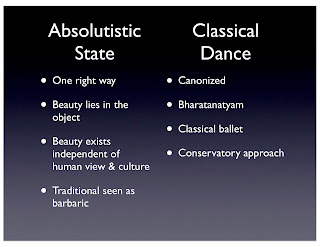
When the Egoistic dancer looks for greater meaning and the traditional and popular forms of dance (Tribal, Folk, Social, Ehtnic) are codified into a canon, the classical forms emerge—like Bharatanatyam (one of eight forms of Indian classical dance) or classical ballet . In the western world, ethnic court dancing transitioned into classical ballet with the canonization that came from Pierre Beauchamp and Jean-Georges Noverre . For the purpose of this series of posts, which follow the development of western concert dance, I will focus on ballet as the exemplar of the classical credo. Classicism fits in with the Gravesian framework in the Absolutistic state of thinking. Graves wrote, “Thinking at this level is absolutistic: one right way and only one right way to think about anything”. From a classical/absolutistic perspective, there is one superior form of dance. All other forms are barbaric or the work of savages who are not sophisticated enough to appreciate the object...