Posts

Showing posts with the label dance teaching

Creative Process

In Making Your Life as an Artist , Andrew Simonet writes, “The scientific method and the artistic process are the two most robust problem-solving methodologies ever developed. Take either one away, and our world would be unrecognizable.” As an artist and educator, my life is built around the practice, study, and teaching of the artistic or creative process. I am passionate about it. It is what excites and energizes me to get up each day and walk into the classroom or studio. However, incoming freshman dance majors, students choosing to pursue fine arts degrees, often are more able to recite the scientific method, or even elements of critical thinking, than they are stages of the creative process. I imagine that this is partly because we do not give creative process much weight in our education systems and partly because these students often believe in the myth that creativity is something that starry-eyed, eccentrics are gifted with and the rest of us, the level-headed...
Remembering Luigi

With the news of the passing of jazz dance legend Luigi , I dug up this online article I wrote 15 years ago about him. With a deep bow of reverence to the man and his contribution... Class with Luigi On the back cover of Luigi's Jazz Warm Up, movie star John Travolta says, "Luigi always defined Jazz dancing for me in the same unique form that Jack Cole did."  As I cut through Manhattan's Central Park on my way to Studio Maestro, where 75 year old jazz dance legend Luigi currently teaches, I am reminded of the movie Staying Alive - the sequel to Saturday Night Fever. In Staying Alive, John Travolta plays an ex-disco dancer who turns professional Broadway dancer. While the script and the acting of Staying Alive were poor (a tradition that has been carried on by other dance movies such as Showgirls and more recently, Center Stage), John Travolta, restrained to only a few small dance combinations and a loin cloth, looked surprisingly professional. As legend has it...

Transmodernism: Integrating the Art and Science of Movement

This Thursday and Friday (Mar 14 & 15, 2014) I will speak at the research symposium Transmodernism: Integrating the Art and Science of Movement at the University of Wisconsin-Milwaukee. I feel excited and privileged to be part of this community of movement artists and specialists that I deeply respect, exploring the potential of movement in the 21st century. When most people think of dancers, they envision fit, active, lithe creatures. They don't often think of dancers as nerds. But, if you define nerds as people inordinately passionate and mentally fixated on their particular interests, then dancers can be just as nerdy as anyone. And, I say this lovingly, this symposium promises to prove it. My presentation, Transmodernism in Dance , will explore my research of Dance Paradigms using the Gravesian Framework which I have outlined in this blog. I continue to find new depths and wrinkles in this area of research. Currently, I have been exploring its application in a variety...

Premiere of Courtly Dances from Gloriana April 14, 2012

Image
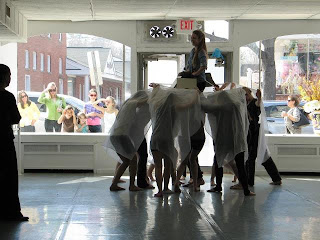
Last night was the premiere of a collaborative work between the Ridgefield Symphony Orchestra , the Ridgefield Guild of Artists , and the Ridgefield Conservatory of Dance . The event went beautifully and it was interesting to see these organizations working together, especially from the point of view of the Dance Paradigms . A strongly conventional, classical-minded audience supports the Ridgefield Symphony Orchestra. The current artists-in-residence at the Ridgefield Guild of Artists, sculptor Justin Perlman and performance artist Adelka Polak , are contemporary artists. My students from the Ridgefield Conservatory of Dance have a strong classical foundation in ballet balanced with experience in modern and contemporary dance, including exposure to contemporary composition and improvisation. I guess the biggest question for me going into this project was whether the gap between the symphony’s classical paradigm and the artists’ contemporary paradigm would be difficult to bridge. ...

CelloPointe Rehearsal Day 3

I have been so silent on here recently--sorry. I promise that will end soon. I have been preoccupied with a variety of projects/events:  performance and residency at Scotland Elementary School,  rehearsals for a performance with the Ridgefield Symphony Orchestra ,  performances of the Ridgefield Rhythm Tap Ensemble,  being on a committee for Advancing Creative Thinking: Imagination to Innovation , students preparing their own choreography for Draw On! at the Aldrich Contemporary Arts Museum , and a whole lot of traveling.  Coming up this weekend is a premiere of a new work I created with Morgan Stinnett and Dona Wiley of Connecticut Ballet . I shared the first rehearsal in the last post …here is a clip from the third rehearsal . This Friday, the new work will debut in CelloPointe   and features choreography by Deborah Wingert , Emery Lecrone , Michele Gargan, and myself. If you are local and enjoy live music and dancing, please join us on Friday Marc...

Dance Paradigms (Part 9: Applications for Dance Education)

Image
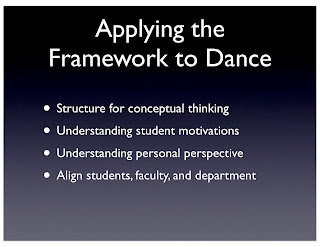
So, how can the Graves framework be incorporated and applied to dance education? I think it can offer an organizational structure for college dance students that will introduce conceptual thinking toward their craft. While not all undergraduate students would care to understand the development of dance beyond the platitudes they often hear, some may gain a greater understanding of the ideas behind the movements.    Of all the arts, dancers are often saved from the rigors of intellectual thought because we are physical artists and not to be labored with such thinking. However, I believe that this is an old Cartesian modernist mind-body prejudice. Presenting the information will at least give those dancers that are interested the ability to grow into knowledgeable, passionate, thinking artists. And for those who would rather not consider it, we would just accept that they are in the state that suits their current psychological conditions. At the dance studio in Long Island ...

Dance Paradigms (Part 8: Transmodern Dance)

Image
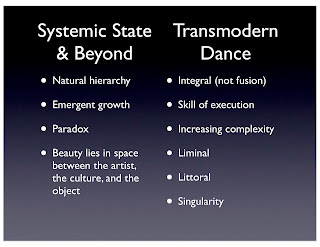
Graves suggests the next level beyond Relativistic postmodernism is the Systemic state. The Systemic state builds off of the strengths and weaknesses of the Relativistic state. The pluralistic relativism that postmodernism brought to our society insisted on seeing all states as equal in order to upend oppressive hierarchies. In seeing traditional dance as equal to classical as equal to modern as equal to postmodern, relativistic thinking ignored the natural increase in complexity and growth. Systemic thinking, in contrast, embraces this pattern of development as a natural, not oppressive, hierarchy. Systemic thinking believes that universals do once again exist, but that most of what we understand is contextual and we could never know for sure that the universals we personally believe in are indeed universal. Therefore, Systemic thinking is comfortable with paradox. Beauty does not lie in the object alone, or in the artist alone, or in the viewer alone. Beauty lies in ...