Posts

Showing posts with the label contemporary dance

Creative Process Speech at The President's Faculty Dinner and Lecture

Image
Creative Process speech given at the President's Faculty Dinner and Lecture for Webster University at Bissinger's Historic Chocolate Factory in St. Louis on August 20, 2015.

Creative Process

In Making Your Life as an Artist , Andrew Simonet writes, “The scientific method and the artistic process are the two most robust problem-solving methodologies ever developed. Take either one away, and our world would be unrecognizable.” As an artist and educator, my life is built around the practice, study, and teaching of the artistic or creative process. I am passionate about it. It is what excites and energizes me to get up each day and walk into the classroom or studio. However, incoming freshman dance majors, students choosing to pursue fine arts degrees, often are more able to recite the scientific method, or even elements of critical thinking, than they are stages of the creative process. I imagine that this is partly because we do not give creative process much weight in our education systems and partly because these students often believe in the myth that creativity is something that starry-eyed, eccentrics are gifted with and the rest of us, the level-headed...

Transmodernism: Integrating the Art and Science of Movement

This Thursday and Friday (Mar 14 & 15, 2014) I will speak at the research symposium Transmodernism: Integrating the Art and Science of Movement at the University of Wisconsin-Milwaukee. I feel excited and privileged to be part of this community of movement artists and specialists that I deeply respect, exploring the potential of movement in the 21st century. When most people think of dancers, they envision fit, active, lithe creatures. They don't often think of dancers as nerds. But, if you define nerds as people inordinately passionate and mentally fixated on their particular interests, then dancers can be just as nerdy as anyone. And, I say this lovingly, this symposium promises to prove it. My presentation, Transmodernism in Dance , will explore my research of Dance Paradigms using the Gravesian Framework which I have outlined in this blog. I continue to find new depths and wrinkles in this area of research. Currently, I have been exploring its application in a variety...

I Don't Get It

Image
Artist Molly Brennan installing sculpture At a faculty event recently one of my senior colleagues shared that she just doesn’t get art, or dance. While that disappoints me in some ways, I found her honesty refreshing. The natural urge to search for meaningful patterns in life, leads many, when looking at art, or dance, to the same exasperated revelation: “I don’t get it.” The truth is, more often than not, there is nothing specific to get. Art can be, but is not often, about communicating a clear, specific message. From my perspective, it is most often about the experience, the spark of connection, between the artwork, the viewer, and the artist—not the message. For example, a series of singular events, makes no attempt to convey a message. Rather, the work developed out of an exploration of three continuums: the micro to the macro, the biological to the technological, and the fragmented (singular) to the connected (series). If I arrived at any final me...

a series of singular events premiering April 12

In a week I will premiere my first work for the Webster University Dance Ensemble. The piece, a series of singular events , began as the Singularity Project and I have shared elements of the creative process that went into its creation here on this blog. While movement phrases--and their development--have been posted here, I have not talked much about the technological aspects of the work. First, I created a soundscape by editing and mixing recordings of Tibetan singing bowls, electronic chamber music, and good old analog television static. Does digital cable television have static? I wonder if there soon will be a day where, when I use the word static, young kids will look at me as if I am speaking a foreign language—much like they do now when I mention a typewriter. Anyway, I used Logic Express software on a MacBook Pro to create the soundscape. In addition to the soundscape, I created a video collage from public domain footage I gathered from creativecommons.com. I edited th...

CelloPointe Concert March 30, 2012

Image
The CelloPointe concert went well; I am truly pleased with Dona and Morgan’s performance. As for the choreography, there are moments that intrigue me and others that I don’t like. Of course, this is typical. The creative process is, if anything, a process of revision. A piece is only finished when one stops working on it. And, sharing that aspect of dance-making here in this blog is part of my commitment to be open about the process. From my perspective, the successful aspects of the dance were (1) a handful of images I found intriguingly beautiful and (2) the flow of the phrasing. I am not going to point out the specific images I found intriguing here because I would like to get feedback (which I am going to ask for below) and I don’t want to influence authentic responses. What I will share right now, are some issues that I am struggling with in the dance. Below is an excerpt of the dance that includes the pas de deux (Bach Sarabande). Prior to the duet, there is a short solo (Gavot...

Premiere of Courtly Dances from Gloriana April 14, 2012

Image
Last night was the premiere of a collaborative work between the Ridgefield Symphony Orchestra , the Ridgefield Guild of Artists , and the Ridgefield Conservatory of Dance . The event went beautifully and it was interesting to see these organizations working together, especially from the point of view of the Dance Paradigms . A strongly conventional, classical-minded audience supports the Ridgefield Symphony Orchestra. The current artists-in-residence at the Ridgefield Guild of Artists, sculptor Justin Perlman and performance artist Adelka Polak , are contemporary artists. My students from the Ridgefield Conservatory of Dance have a strong classical foundation in ballet balanced with experience in modern and contemporary dance, including exposure to contemporary composition and improvisation. I guess the biggest question for me going into this project was whether the gap between the symphony’s classical paradigm and the artists’ contemporary paradigm would be difficult to bridge. ...

CelloPointe Rehearsal Day 3

I have been so silent on here recently--sorry. I promise that will end soon. I have been preoccupied with a variety of projects/events:  performance and residency at Scotland Elementary School,  rehearsals for a performance with the Ridgefield Symphony Orchestra ,  performances of the Ridgefield Rhythm Tap Ensemble,  being on a committee for Advancing Creative Thinking: Imagination to Innovation , students preparing their own choreography for Draw On! at the Aldrich Contemporary Arts Museum , and a whole lot of traveling.  Coming up this weekend is a premiere of a new work I created with Morgan Stinnett and Dona Wiley of Connecticut Ballet . I shared the first rehearsal in the last post …here is a clip from the third rehearsal . This Friday, the new work will debut in CelloPointe   and features choreography by Deborah Wingert , Emery Lecrone , Michele Gargan, and myself. If you are local and enjoy live music and dancing, please join us on Friday Marc...

CelloPointe Rehearsal Day 1

Today I began rehearsals for a new piece to be premiered in a concert on March 30th. The concert, “CelloPointe”, fuses contemporary ballet and all live cello performances. There is an impressive roster of choreographers, musicians, and dancers on board and I am excited to be involved. My contribution is an original work set on Dona Wiley and Morgan Stinnett—both from the Connecticut Ballet . Dona was a student of mine and I set pieces on her last year for the concert "String Theory." This was my first time meeting Morgan. It turns out that he is from Akron, OH—small world after all. He studied with Nan Klinger, took a class from my ballet teacher Inna Stabrova, and was even in a piece my dear friend Bill Hastings set on the Cuyahoga Valley Youth Ballet. I try to avoid gross generalizations, but Morgan supports the one about Midwesterners being easy to get along with. Both Dona and Morgan are really generous and humble young artists and I really appreciate that. We began g...

Dance Paradigms (Part 9: Applications for Dance Education)

Image
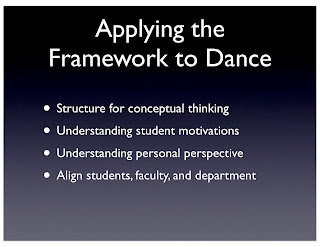
So, how can the Graves framework be incorporated and applied to dance education? I think it can offer an organizational structure for college dance students that will introduce conceptual thinking toward their craft. While not all undergraduate students would care to understand the development of dance beyond the platitudes they often hear, some may gain a greater understanding of the ideas behind the movements.    Of all the arts, dancers are often saved from the rigors of intellectual thought because we are physical artists and not to be labored with such thinking. However, I believe that this is an old Cartesian modernist mind-body prejudice. Presenting the information will at least give those dancers that are interested the ability to grow into knowledgeable, passionate, thinking artists. And for those who would rather not consider it, we would just accept that they are in the state that suits their current psychological conditions. At the dance studio in Long Island ...

Dance Paradigms (Part 8: Transmodern Dance)

Image
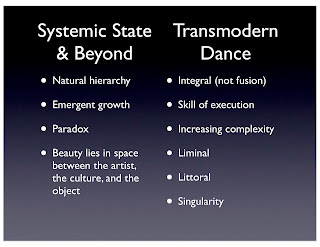
Graves suggests the next level beyond Relativistic postmodernism is the Systemic state. The Systemic state builds off of the strengths and weaknesses of the Relativistic state. The pluralistic relativism that postmodernism brought to our society insisted on seeing all states as equal in order to upend oppressive hierarchies. In seeing traditional dance as equal to classical as equal to modern as equal to postmodern, relativistic thinking ignored the natural increase in complexity and growth. Systemic thinking, in contrast, embraces this pattern of development as a natural, not oppressive, hierarchy. Systemic thinking believes that universals do once again exist, but that most of what we understand is contextual and we could never know for sure that the universals we personally believe in are indeed universal. Therefore, Systemic thinking is comfortable with paradox. Beauty does not lie in the object alone, or in the artist alone, or in the viewer alone. Beauty lies in ...

Dance Paradigms (Part 7: Postmodern Dance)

Image
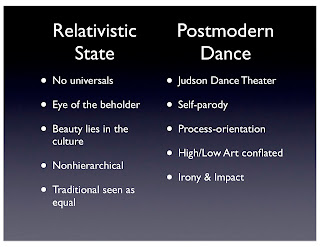
Following the Absolutistic and Multiplistic states, Graves called the next stage of development the Relativistic state. With the Relativistic state, we enter the world of contemporary postmodernism. Beauty is no longer absolute—it is, “created by culture and determined by human view” (Martin-Smith). No universals exist. It is personal to the extreme: whatever the artist says is beautiful is beautiful. Personally, when I tired of the achievement oriented modernist uptown dance scene in New York City, I started to explore different approaches in order to find a more personally relevant voice. And, as my body no longer had the elasticity and bravura strength of my youth, I explored ways of moving that were not simply about spectacular displays of skill. And in this exploration, I started to choreograph. Unfortunately, my palette of movement options was greatly limited by my technical training. I was becoming postmodern in my thinking without an awareness of the postmodern movement i...

Dance Paradigms (Part 6: Modern Dance)

Image
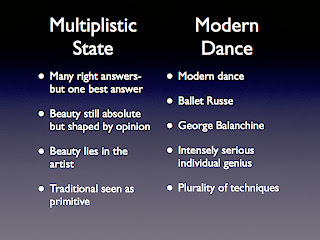
The transition for Graves from the Absolutistic to the Multiplistic existence surfaces in a change from “a submissive state to one of selfish independence”. The shift from Medeival Times into The Enlightenment is the large-scale rendition of this transition. It is Multiplistic because now there are a plurality of right answers—not just one. In the case of the dancer, she begins to question the dogma she has been reared on in order to find the way, perhaps the style, that works for her personally. My final year of college I started to doubt my discipline. I mean, I embraced how it helped me become a much stronger technician than I was when I began, but I no longer idolized classical ballet or Graham technique. I wanted, at that time and for years after, to find the technique or techniques that best helped me improve. For me, that came when I was introduced to Horton technique from a guest artist workshop with Milton Myers. Conservatory programs often straddle the line betwe...

Dance Paradigms (Part 5: Classical Dance)

Image
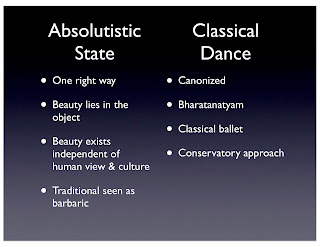
When the Egoistic dancer looks for greater meaning and the traditional and popular forms of dance (Tribal, Folk, Social, Ehtnic) are codified into a canon, the classical forms emerge—like Bharatanatyam (one of eight forms of Indian classical dance) or classical ballet . In the western world, ethnic court dancing transitioned into classical ballet with the canonization that came from Pierre Beauchamp and Jean-Georges Noverre . For the purpose of this series of posts, which follow the development of western concert dance, I will focus on ballet as the exemplar of the classical credo. Classicism fits in with the Gravesian framework in the Absolutistic state of thinking. Graves wrote, “Thinking at this level is absolutistic: one right way and only one right way to think about anything”. From a classical/absolutistic perspective, there is one superior form of dance. All other forms are barbaric or the work of savages who are not sophisticated enough to appreciate the object...

Dance Paradigms (Part 4: Popular Dance)

Image
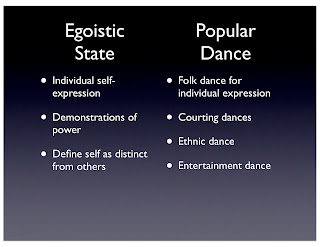
From the group cohesive value systems in Traditional tribal, folk, and social dance, individuals emerge with a desire to express themselves, displaying their prowess, in contrast to others--meeting the needs and motivations of the Gravesian Egoistic system. Here, the individual discovers what Graves calls the “awareness of self as a possibly powerful being separate and distinct from others.” This is found in courting dances, recreational dance studios, Ethnic dance, and entertainment or commercial dance. Courting dances, from those found in the rituals of traditional cultures to the pea-cocking behavior of contemporary college students dancing at the local bar, exhibit traditional Egoistic motivations. On a more personal level, I started dance classes at thirteen and enjoyed the camaraderie of my classmates more than anything else. I felt I belonged within the group. Over time, I began to gain confidence in my ability and wanted to explore how I could express my individual pr...

Dance Paradigms (Part 3: Traditional Dance)

Image
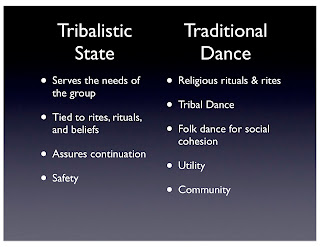
The use of the word ‘traditional’ in dance often describes anything that is older or preceding the current point of view. For instance, to Martha Graham and her disciples, ballet is a traditional dance form, but to members of the postmodern Judson Church movement, Graham’s technique is a traditional modern dance form. While each form and paradigm has its traditions, I use 'traditional' as it refers to the perspectives that pre-date classical, modern, and postmodern times. For dance, this includes tribal and folk (or social) dance. Traditional dance, as I describe it, aligns with Graves’ Tribalistic system. In the Gravesian Tribalistic system, people “develop ritualistic ways full of totems and taboos which is their way to control by incantation and of assuring themselves that they are going to continue to have that which is necessary to take care of their basic needs” (Graves 219). Tribal dance, first and foremost, serves the needs of the group and is tied inextricably ...

Dance Paradigms (Part 2: E-C Theory in a Nutshell)

Image
I am going to boil down Graves' Emergent, Cyclical Theory of Human Existence (what a foreboding title) to three main ideas for understanding dance and artistic movements/eras/paradigms. 1. Motivations Change  Graves proposes that there is not one set of motivations and needs that we humans live by. Rather, that our motivations and needs evolve as we mature because “humans tend normally to change their biopsychosocial being as the conditions of their existence change” (Graves 507). Perspectives and worldviews shift as we evolve; the absolutist viewpoint of the medieval Catholic Church has shifted over time into a pluralistic viewpoint that allows for a variety of interpretations. As our understanding of the world and our thinking develops, so too does our understanding of art.   2. Develop Through States  Graves research suggests humans psychologically develop through states of existence and “that each system has a general theme for existence which ty...

Dance Paradigms (Part 1)

Image
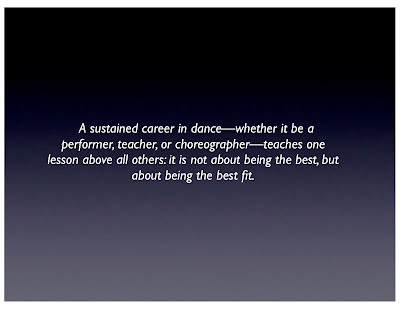
This past October I presented my paper, Dance Movements: From Traditionalism to Postmodernism and Beyond , at the National Dance Education Organization annual conference in Minneapolis. I am excited by the conversations that it sparked and have been thinking of different ways to share the information so that more discussion and feedback could be generated. I am going to try to include it on this blog as a series of posts. So, consider this post number one--the introduction. I should start by explaining that this whole inquiry began with a lesson I learned long ago: a sustained career in dance—whether it be a performer, teacher, or choreographer—is not about being the best, but about being the best fit. I do not simply refer to the cliché where the dancer who gets the job is the one who happens to fit the costumes of the person who they are replacing, although that does apply. Instead, I refer to the idea that there is not one ‘best’ dancer, teacher, or choreographer. There are o...