Posts

Showing posts with the label choreography

Creative Process Speech at The President's Faculty Dinner and Lecture

Image
Creative Process speech given at the President's Faculty Dinner and Lecture for Webster University at Bissinger's Historic Chocolate Factory in St. Louis on August 20, 2015.

Creative Process

In Making Your Life as an Artist , Andrew Simonet writes, “The scientific method and the artistic process are the two most robust problem-solving methodologies ever developed. Take either one away, and our world would be unrecognizable.” As an artist and educator, my life is built around the practice, study, and teaching of the artistic or creative process. I am passionate about it. It is what excites and energizes me to get up each day and walk into the classroom or studio. However, incoming freshman dance majors, students choosing to pursue fine arts degrees, often are more able to recite the scientific method, or even elements of critical thinking, than they are stages of the creative process. I imagine that this is partly because we do not give creative process much weight in our education systems and partly because these students often believe in the myth that creativity is something that starry-eyed, eccentrics are gifted with and the rest of us, the level-headed...

Transmodernism: Integrating the Art and Science of Movement

This Thursday and Friday (Mar 14 & 15, 2014) I will speak at the research symposium Transmodernism: Integrating the Art and Science of Movement at the University of Wisconsin-Milwaukee. I feel excited and privileged to be part of this community of movement artists and specialists that I deeply respect, exploring the potential of movement in the 21st century. When most people think of dancers, they envision fit, active, lithe creatures. They don't often think of dancers as nerds. But, if you define nerds as people inordinately passionate and mentally fixated on their particular interests, then dancers can be just as nerdy as anyone. And, I say this lovingly, this symposium promises to prove it. My presentation, Transmodernism in Dance , will explore my research of Dance Paradigms using the Gravesian Framework which I have outlined in this blog. I continue to find new depths and wrinkles in this area of research. Currently, I have been exploring its application in a variety...

I Don't Get It

Image
Artist Molly Brennan installing sculpture At a faculty event recently one of my senior colleagues shared that she just doesn’t get art, or dance. While that disappoints me in some ways, I found her honesty refreshing. The natural urge to search for meaningful patterns in life, leads many, when looking at art, or dance, to the same exasperated revelation: “I don’t get it.” The truth is, more often than not, there is nothing specific to get. Art can be, but is not often, about communicating a clear, specific message. From my perspective, it is most often about the experience, the spark of connection, between the artwork, the viewer, and the artist—not the message. For example, a series of singular events, makes no attempt to convey a message. Rather, the work developed out of an exploration of three continuums: the micro to the macro, the biological to the technological, and the fragmented (singular) to the connected (series). If I arrived at any final me...

a series of singular events premiering April 12

In a week I will premiere my first work for the Webster University Dance Ensemble. The piece, a series of singular events , began as the Singularity Project and I have shared elements of the creative process that went into its creation here on this blog. While movement phrases--and their development--have been posted here, I have not talked much about the technological aspects of the work. First, I created a soundscape by editing and mixing recordings of Tibetan singing bowls, electronic chamber music, and good old analog television static. Does digital cable television have static? I wonder if there soon will be a day where, when I use the word static, young kids will look at me as if I am speaking a foreign language—much like they do now when I mention a typewriter. Anyway, I used Logic Express software on a MacBook Pro to create the soundscape. In addition to the soundscape, I created a video collage from public domain footage I gathered from creativecommons.com. I edited th...

CelloPointe Concert March 30, 2012

Image
The CelloPointe concert went well; I am truly pleased with Dona and Morgan’s performance. As for the choreography, there are moments that intrigue me and others that I don’t like. Of course, this is typical. The creative process is, if anything, a process of revision. A piece is only finished when one stops working on it. And, sharing that aspect of dance-making here in this blog is part of my commitment to be open about the process. From my perspective, the successful aspects of the dance were (1) a handful of images I found intriguingly beautiful and (2) the flow of the phrasing. I am not going to point out the specific images I found intriguing here because I would like to get feedback (which I am going to ask for below) and I don’t want to influence authentic responses. What I will share right now, are some issues that I am struggling with in the dance. Below is an excerpt of the dance that includes the pas de deux (Bach Sarabande). Prior to the duet, there is a short solo (Gavot...

Premiere of Courtly Dances from Gloriana April 14, 2012

Image
Last night was the premiere of a collaborative work between the Ridgefield Symphony Orchestra , the Ridgefield Guild of Artists , and the Ridgefield Conservatory of Dance . The event went beautifully and it was interesting to see these organizations working together, especially from the point of view of the Dance Paradigms . A strongly conventional, classical-minded audience supports the Ridgefield Symphony Orchestra. The current artists-in-residence at the Ridgefield Guild of Artists, sculptor Justin Perlman and performance artist Adelka Polak , are contemporary artists. My students from the Ridgefield Conservatory of Dance have a strong classical foundation in ballet balanced with experience in modern and contemporary dance, including exposure to contemporary composition and improvisation. I guess the biggest question for me going into this project was whether the gap between the symphony’s classical paradigm and the artists’ contemporary paradigm would be difficult to bridge. ...

CelloPointe Rehearsal Day 3

I have been so silent on here recently--sorry. I promise that will end soon. I have been preoccupied with a variety of projects/events:  performance and residency at Scotland Elementary School,  rehearsals for a performance with the Ridgefield Symphony Orchestra ,  performances of the Ridgefield Rhythm Tap Ensemble,  being on a committee for Advancing Creative Thinking: Imagination to Innovation , students preparing their own choreography for Draw On! at the Aldrich Contemporary Arts Museum , and a whole lot of traveling.  Coming up this weekend is a premiere of a new work I created with Morgan Stinnett and Dona Wiley of Connecticut Ballet . I shared the first rehearsal in the last post …here is a clip from the third rehearsal . This Friday, the new work will debut in CelloPointe   and features choreography by Deborah Wingert , Emery Lecrone , Michele Gargan, and myself. If you are local and enjoy live music and dancing, please join us on Friday Marc...

CelloPointe Rehearsal Day 1

Today I began rehearsals for a new piece to be premiered in a concert on March 30th. The concert, “CelloPointe”, fuses contemporary ballet and all live cello performances. There is an impressive roster of choreographers, musicians, and dancers on board and I am excited to be involved. My contribution is an original work set on Dona Wiley and Morgan Stinnett—both from the Connecticut Ballet . Dona was a student of mine and I set pieces on her last year for the concert "String Theory." This was my first time meeting Morgan. It turns out that he is from Akron, OH—small world after all. He studied with Nan Klinger, took a class from my ballet teacher Inna Stabrova, and was even in a piece my dear friend Bill Hastings set on the Cuyahoga Valley Youth Ballet. I try to avoid gross generalizations, but Morgan supports the one about Midwesterners being easy to get along with. Both Dona and Morgan are really generous and humble young artists and I really appreciate that. We began g...

Dance Paradigms (Part 9: Applications for Dance Education)

Image
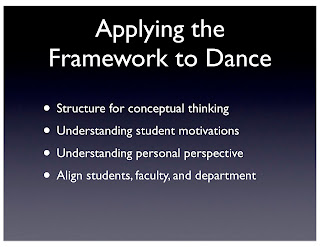
So, how can the Graves framework be incorporated and applied to dance education? I think it can offer an organizational structure for college dance students that will introduce conceptual thinking toward their craft. While not all undergraduate students would care to understand the development of dance beyond the platitudes they often hear, some may gain a greater understanding of the ideas behind the movements.    Of all the arts, dancers are often saved from the rigors of intellectual thought because we are physical artists and not to be labored with such thinking. However, I believe that this is an old Cartesian modernist mind-body prejudice. Presenting the information will at least give those dancers that are interested the ability to grow into knowledgeable, passionate, thinking artists. And for those who would rather not consider it, we would just accept that they are in the state that suits their current psychological conditions. At the dance studio in Long Island ...

Dance Paradigms (Part 8: Transmodern Dance)

Image
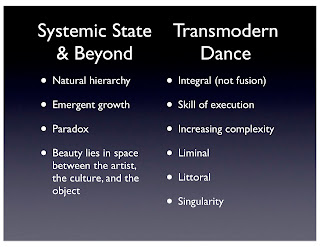
Graves suggests the next level beyond Relativistic postmodernism is the Systemic state. The Systemic state builds off of the strengths and weaknesses of the Relativistic state. The pluralistic relativism that postmodernism brought to our society insisted on seeing all states as equal in order to upend oppressive hierarchies. In seeing traditional dance as equal to classical as equal to modern as equal to postmodern, relativistic thinking ignored the natural increase in complexity and growth. Systemic thinking, in contrast, embraces this pattern of development as a natural, not oppressive, hierarchy. Systemic thinking believes that universals do once again exist, but that most of what we understand is contextual and we could never know for sure that the universals we personally believe in are indeed universal. Therefore, Systemic thinking is comfortable with paradox. Beauty does not lie in the object alone, or in the artist alone, or in the viewer alone. Beauty lies in ...

Dance Paradigms (Part 7: Postmodern Dance)

Image
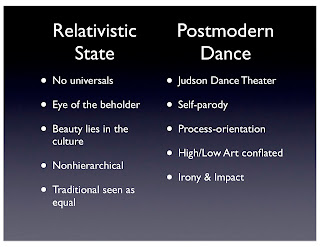
Following the Absolutistic and Multiplistic states, Graves called the next stage of development the Relativistic state. With the Relativistic state, we enter the world of contemporary postmodernism. Beauty is no longer absolute—it is, “created by culture and determined by human view” (Martin-Smith). No universals exist. It is personal to the extreme: whatever the artist says is beautiful is beautiful. Personally, when I tired of the achievement oriented modernist uptown dance scene in New York City, I started to explore different approaches in order to find a more personally relevant voice. And, as my body no longer had the elasticity and bravura strength of my youth, I explored ways of moving that were not simply about spectacular displays of skill. And in this exploration, I started to choreograph. Unfortunately, my palette of movement options was greatly limited by my technical training. I was becoming postmodern in my thinking without an awareness of the postmodern movement i...

NDEO Conference Day 2

Day 2 of the conference began with an early breakfast/awards/business meeting. That was followed with a jazz class with Billy S. His dynamic energy comes out not only in his class but in the way that he talks and walks. Truly the only instance in my life where, with all seriousness, I can call someone a true “swingin’ cat.” Over lunch I did some work on my presentation and then found an Office Depot to reprint my handout. While checking out the white board setup in the space I will be presenting in I ran into Shirlene from Long Island School of the Arts. It has been about 10 years! She was great to work for and with and I get a kick out of how simultaneously both big and small the dance world is. I attended a panel discussion on collective/collaborative models of dance making. It brought up many questions for me about the modernist ‘one person/one vision’ company model versus the project-based model versus the collaborative and collective models. A couple of the panelists were tr...

New Beginnings: The Birth of a Dance

Image
“Art is like beginning a sentence before you know its ending." ~ Bayles & Orland from Art & Fear I love sitting on the precipice of a new project, that moment so pregnant with possibility and full of promise. Inevitably, with each decision, each step forward, each new development, the work begins to define itself and I have to give up that wonderful place of pure potential. “What's so hard about that first sentence is that you're stuck with it. Everything else is going to flow out of that sentence. And by the time you've laid down the first two sentences, your options are all gone.” ~ Joan Didion That loss, however, is countered with the sense of wonder I feel as the new work unfolds itself. And that excites me. In rehearsal for Missa Pro Dogmata So, I am beginning to work on a new piece, which for now I will dub the Singularity Project . This is the second part of my seven-part 7 Veils Series that draws its inspiration from author Tom Robbins’ book ...

What's With The Hat?

Image
Photo credit: Sherryl Hauck Sometimes I wear a hat (see the photo to the left). The reaction to it from my dance students really depends on their age. The middle schoolers think it’s cool, “I love your hat Mr. Robey.” The high schoolers tend to jeer, “What’s with the hat?” I even heard one student remark to another that it was “to hide his receding hair line.” Luckily, I am blessed by my Grandpa Walt (my mother’s father) who at 81 still has a full head of hair and has passed that trait on to me. Yet the question remains, “What’s with the hat?” An easy, simple answer is that it is my personal piece of flair. I make my living as an artist and teacher after all so a Trilby Hat and Christmas-plaid Converse are acceptable parts of the uniform. However, there is more to it; there is a history to the hat that relates to my life as a dance-artist. But before I can go there, I have to tell you about my first hat. I loved that hat. When I was in Junior High, after a conversation about t...

Change of Space

Image
I spent the past two nights in the theater preparing my students for their annual Spring Concert. What struck me as interesting is that the transition from one space to another is completely disorienting at first. On Monday we moved the younger students from the small studio into the big studio for a rehearsal. This threw many of them completely off. The change of space, the new environment made what was regularly well rehearsed and comfortable into something foreign and frightening. The next step was moving them all onto the stage in the theater (change of space #2) and, again, the reaction was the same. It takes time for them to adjust and get their bearings. They are kids and they are learning so this is to be expected. But, it made me think how in life there lies a parallel. I love the sense of ease and peace I get on vacation--especially if it involves the sand, the ocean, and the sun. I soak in that stress-free feeling and vow to take it home with me. Nevertheless, when I get b...